
Elucidating the role of physiologic and metabolic factors in lung tumorigenesis
Metabolic reprogramming, oxidative stress and lung cancer
Kras-driven non-small cell lung cancer (NSCLC) remains one of the most aggressive and lethal solid tumors. ~20% of Kras-driven NSCLC acquire mutually exclusive activating mutations in the anti-oxidant transcription factor NRF2 or inactivating mutations in its negative regulator KEAP1. The anti-oxidant transcription factor NRF2 acts as the primary line of cellular defense against reactive oxygen species (ROS) by rewiring metabolism to maintain oxidative homeostasis
Using a combination of a Kras-driven genetically engineered mouse model and somatic CRISPR/Cas9 genome-engineering approaches we have demonstrated the functional importance of NRF2/KEAP1 pathway in lung tumorigenesis. Using both metabolomic and focused genetic screening methods we are systematically indentifying novel mechanisms underlying the role of Nrf2/Keap1 pathway in lung cancer. We find unique metabolic dependancies in Nrf2/Keap1 mutant lung cancer cells which we validate by both genetic and biochmeical approaches. These dependancies highlight metabolic vulnerabilities in cells with increased anti-oxidant production due to alteration in the Nrf2/Keap1 pathway, which can we are exploiting as novel metabolism-based therapeutic strategies for lung cancer.
Davidson SM, Papagiannakopoulos T, Olenchock BA, Heyman JE, Keibler MA, Luengo A, Bauer MR, Jha AK, O'Brien JP, Pierce KA, Gui DY, Sullivan LB, Wasylenko TM, Subbaraj L, Chin CR, Stephanopolous G, Mott BT, Jacks T, Clish CB, Vander Heiden MG. Environment Impacts the Metabolic Dependencies of Ras-Driven Non-Small Cell Lung Cancer. Cell Metab. 2016 Feb 3. pii: S1550-4131(16)00041-3. doi: 10.1016/j.cmet.2016.01.007. [Epub ahead of print]
Circadian rhythm disruption promotes lung cancer
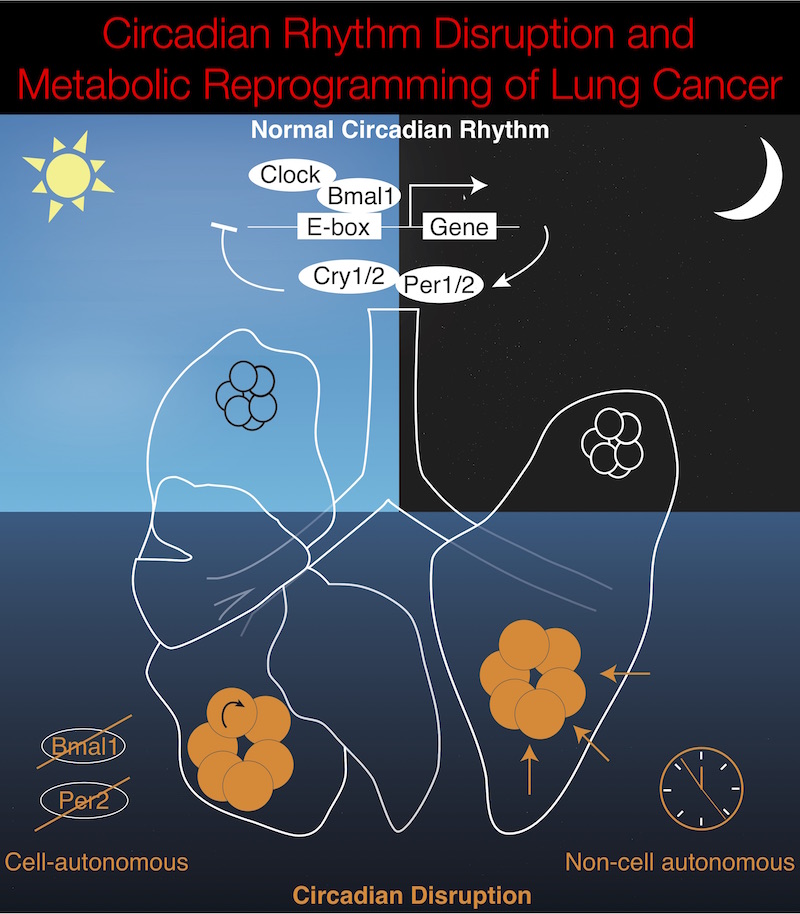
Despite extensive characterization of genetic events that contribute to cancer, the impact of environmental/physiologic factors on tumorigenesis remains poorly understood. A major consequence of a modern lifestyle is the disruption of circadian rhythms. A plethora of epidemiological studies have revealed that the risk for many types of cancer, including lung, is significantly higher among shift-workers. In 2010, the World Health Organization and the International Agency for Research on Cancer, published an assessment on carcinogenicity of shift-work which concluded: “shift-work that involves circadian disruption is probably carcinogenic to humans”. This raises many concerns, since in the US alone, it is estimated that 20% of the US work force is subjected to shifting work schedule.
Circadian rhythm disruption by shift-work is associated with greater risk for cancer development and poor prognosis, suggesting a putative tumor suppressive role for circadian rhythm homeostasis. Circadian rhythms are 24-hour oscillations that control a variety of biological processes in living systems, including two hallmarks of cancer, cell division and metabolism.
Using a GEMMs of lung cancer, we are characterizing the effects of circadian rhythm disruption on lung tumorigenesis. We demonstrate that both physiologic perturbation (jet lag) and genetic mutation of the central circadian clock components decreased survival and promoted lung tumor growth and progression.
Papagiannakopoulos, T., Bauer, M., Davidson, S., Heimann, M. , Subbaraj, L., Bhutkar, A., Bartlebaugh, J., Vander Heiden, M., Jacks, T. Circadian Rhythm Disruption Promotes Lung Tumorigenesis. Cell Metabolism. (2016).
Masri S, Papagiannakopeoulos T, Kinouchi K, Liu Y, Cervantes M, Baldi P, Jacks T, Sassone-Corsi P. Lung Adenocarcinoma Distally Rewires Hepatic Circadian Homeostasis. Cell. 2016; 165(4):896-909. PubMed [journal] PMID: 27153497